
The Java frameworks your team picks determine how fast you ship, how well your systems scale, and how productive your developers are day to day. Here's a comprehensive look at the Java framework landscape in 2026 — and where Vaadin fits in.
The Short Answer: Spring Boot Leads, but That's Not the Whole Story
If you're asking what the most popular Java framework is in 2026, the answer by adoption is Spring Boot. According to the 2025 Stack Overflow Developer Survey, Spring Boot is used by roughly 14.7% of developers across all web frameworks and earns a 53.7% admiration score. It remains the default choice for most new Java web projects — and for good reason: it has the largest ecosystem, the best documentation, mature cloud-native tooling, and by far the biggest community.
But popularity alone doesn't make a framework the right choice for your project. The Java ecosystem in 2026 is more specialized than ever. Each framework excels at different things, and choosing the wrong one can cost your team months.
Let's break down the landscape.
The Top Java Frameworks in 2026
1. Spring Boot — The Enterprise Standard
Spring Boot remains the dominant way to build modern Java backends. Built on top of the broader Spring ecosystem, it provides auto-configuration, embedded servers, and production-ready tooling that dramatically reduces boilerplate. Teams use it to build microservices, REST APIs, and large-scale enterprise systems that integrate with messaging, databases, security, and cloud platforms.
With the arrival of Spring AI in 2026, Spring Boot has expanded further — offering built-in support for integrating large language models and AI services into Java applications. Combined with Spring Security, Spring Data, Spring Cloud, Spring Batch, and Actuator, it provides a complete backend toolkit.
Best for: Large enterprise applications, teams that need a full backend ecosystem, and organizations pursuing cloud-native digital transformation.
Trade-off: Spring Boot is primarily a backend framework. For rich web UIs, you still need a separate frontend technology — React, Angular, or a Java-based UI framework like Vaadin.
2. Quarkus — The Cloud-Native Challenger
Quarkus has matured into one of the most compelling Java frameworks for cloud-native development. Built from the ground up for Kubernetes and GraalVM, it achieves sub-second startup times and minimal memory consumption. Its live coding feature lets developers see changes instantly without restarting the application.
In 2026, many teams view Quarkus as the go-to choice for high-performance API services, event-driven architectures, and edge workloads where efficiency directly impacts cloud costs.
Best for: Microservices, serverless deployments, and container-dense environments where startup time and memory usage matter.
Trade-off: The ecosystem is smaller than Spring Boot's. Not all libraries and integrations are fully compatible yet.
3. Micronaut — Lightweight and Fast
Micronaut excels in memory-constrained environments thanks to compile-time dependency injection, which eliminates reflection entirely. It achieves a smaller memory footprint than even Quarkus and pairs well with serverless functions on AWS Lambda and similar platforms.
Best for: Serverless functions, IoT services, and any workload where a minimal memory footprint is a hard design requirement.
Trade-off: Smaller community and fewer extensions compared to Spring Boot and Quarkus.
4. Jakarta EE — The Standards-Based Foundation
Jakarta EE (formerly Java EE) remains the official standards-based platform for enterprise Java. Now fully governed by the Eclipse Foundation, it has become more modular and aligned with modern deployment models. Jakarta EE 11, released in 2025, introduced specifications that make it easier to adopt selectively for microservices and containerized environments.
Best for: Heavily regulated industries, government projects, and organizations that prefer standards-based specifications over vendor-specific frameworks.
Trade-off: Slower feature adoption compared to community-driven frameworks.
5. Hibernate — The Persistence Layer That Endures
Hibernate remains the most widely used object-relational mapping (ORM) framework in Java. It abstracts away the repetitive boilerplate of SQL and database access. In 2026, it continues to serve as a core building block, frequently paired with Spring Data JPA, Jakarta EE, Quarkus, and Micronaut.
Best for: Data-intensive applications, transactional systems, and any domain where a robust ORM is essential. Note that Hibernate is typically used alongside another framework rather than as a standalone web framework.
6. Vaadin — Full-Stack Web Apps in Pure Java
Vaadin is the only major open-source framework that lets you build a modern, reactive web UI entirely in Java. No separate JavaScript layer. No hand-written REST APIs. No complex frontend-backend state synchronization.
With Vaadin, your UI components live on the server. The framework handles browser communication and securely renders HTML and CSS. You write Java — the same language you use for your business logic and data access — and Vaadin handles the rest.
Best for: Business applications, internal tools, dashboards, and any project where your team has strong Java skills but limited frontend JavaScript resources.
Why Java Developers Should Take a Closer Look at Vaadin in 2026
Spring Boot may dominate the conversation, but the question of which framework fits your project best is different from which framework is most popular. For a significant segment of real-world Java development — enterprise business applications — Vaadin offers advantages that no other framework can match.
The Full-Stack Java Advantage
In 2026, most Java web architectures still follow the same pattern: a Spring Boot backend paired with a React or Angular frontend. This means your team needs to maintain expertise in two different languages, two build systems, two testing frameworks, and the REST API contract that connects them.
Vaadin eliminates that split. A single development team can own a feature from database to browser. Using one language across the entire stack simplifies development, debugging, and code reviews. Server and client share business logic and validation rules, reducing bugs and eliminating redundancy.
Enterprise-Grade Components Out of the Box
Vaadin ships with a comprehensive library of UI components — text fields, buttons, combo boxes, data grids, date pickers, and dozens more — all built on the open W3C Web Components standard. These components are:
- Accessible by default — WCAG 2.1 AA compliant, aligned with EU and US accessibility regulations.
- Themable — Easily customizable with CSS custom properties and a powerful styling system.
- Designer-friendly — A high-fidelity Figma library lets designers create mockups that map directly to real Vaadin components.

The Card component is a versatile container for grouping related content and actions, with several customization options for layout and appearance.
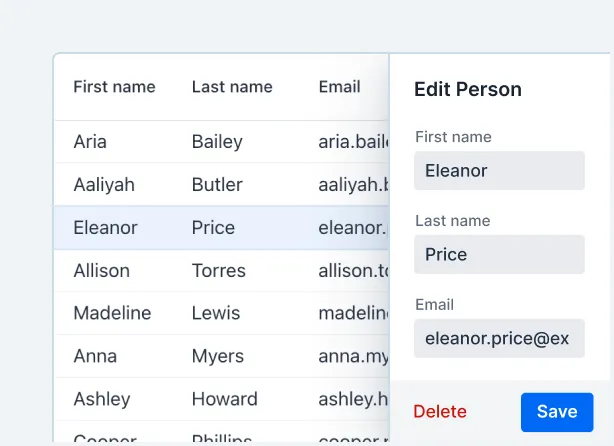
CRUD is a component for managing a dataset.
Security Built into the Architecture
Because Vaadin's server-side model keeps most UI logic on the server rather than in the browser, it significantly reduces the attack surface compared to client-side frameworks where application logic is exposed to the end user. This is a major advantage for industries where Vaadin is widely used in production: banking, insurance, healthcare, aerospace, and government.
Long-Term Support and Stability
Enterprise applications need to last. Vaadin offers up to 15 years of support per major version, along with automated migration tooling. When you're building software that needs to run reliably for a decade or more, that commitment matters.
AI-Assisted Development
In 2026, Vaadin ships with Copilot — an AI assistant that blends visual editing and coding for Vaadin projects. Changes made with Copilot appear instantly in your IDE, keeping your codebase as the single source of truth. Use it to scaffold views, generate mock data, or draft the first version of a new feature.
How to Choose the Right Java Framework in 2026
| Your Situation | Recommended Framework |
|---|---|
| General-purpose backend and microservices | Spring Boot |
| Kubernetes-first, serverless, or scale-to-zero | Quarkus |
| Ultra-low-memory serverless functions | Micronaut |
| Standards-based enterprise systems | Jakarta EE |
| Full-stack business web apps in pure Java | Vaadin |
| Reactive systems with high concurrency | Vert.x or Play Framework |
In practice, many production architectures combine multiple Java frameworks. One of the most popular and powerful combinations in 2026 is Spring Boot + Vaadin. Spring Boot handles backend infrastructure, dependency injection, security, and data access. Vaadin handles the UI layer. Everything stays in Java, in one codebase, in the same IDE.
The Bottom Line
By market share and community size, Spring Boot is the most popular Java framework in 2026 — and that isn't changing anytime soon. But popularity and fit are not the same thing.
Vaadin is the framework that lets your team build business-critical web apps while keeping everything in pure Java — from the database to the browser. With enterprise-grade components, built-in accessibility, long-term support, and a security model built for the most demanding applications, it's trusted by hundreds of thousands of developers at companies of all sizes, from startups to the Fortune 500.
The best Java framework is the one that helps your team deliver high-quality software, fast.
Ready to try it? Vaadin is open source under the Apache 2.0 license, integrates seamlessly with Spring Boot, and you can have your first app running in minutes.